Drip vs. Sprinklers in Phoenix: What's the Difference?
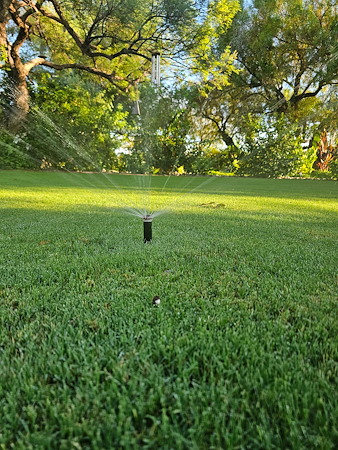
Many Phoenix homeowners refer to their entire irrigation system as "sprinklers." In reality, most residential irrigation systems in Phoenix, AZ include two different watering methods: sprinkler systems and drip irrigation systems.
Both systems work very well when used for their intended application. The difference is simply what they are designed to water and how water is delivered to the plant's root zone.
In most Phoenix landscape irrigation systems:
- Sprinklers are used for grass areas
- Drip irrigation is used for trees, shrubs, gardens, groundcovers, perennials, and annual plantings
Understanding the difference helps homeowners better understand how their irrigation system works and why different parts of the yard are watered differently.
Why Sprinklers Are Used for Grass
Sprinklers are designed to provide even coverage across an entire area, which is exactly what grass requires.
Grass grows densely across the entire surface of the soil, so the entire lawn needs water evenly distributed. Sprinkler systems are designed to create overlapping coverage so every part of the lawn receives consistent moisture.
In Phoenix, most lawns consist of:
- Bermuda grass during the summer
- Overseeded rye grass during the winter
Because rye grass is grown from seed each winter, sprinklers are required to germinate the seed and keep the surface evenly moist during establishment.
There are irrigation systems that use drip irrigation below the soil surface for turf, but they are rarely used in residential irrigation systems in Phoenix because lawns that are overseeded each winter require sprinklers to properly germinate the seed.
For most residential lawns in the Valley, sprinkler irrigation remains the practical and reliable solution for watering grass.
Homeowners also commonly refer to all irrigation as "sprinklers," but there are actually different types of sprinkler heads used in Phoenix lawn irrigation systems.
Spray Heads
Spray heads can use fixed or adjustable nozzles and apply water in a fan pattern. They are typically used in smaller lawn areas but often apply water too quickly for Phoenix desert soils, which can lead to runoff if watering times are not managed carefully.
Rotors
Rotor sprinklers rotate streams of water over a larger area and apply water more slowly than spray heads, making them better suited for larger lawn sections.
Rotary
These are high-efficiency rotating nozzles that apply water at a much slower rate than traditional spray nozzles, helping water soak into the soil more effectively while reducing runoff.
Each type of sprinkler is designed for a specific spacing, pressure range, and application rate to ensure the lawn receives uniform watering.
Why Drip Irrigation Is Used for Trees, Shrubs, and Garden Plants
Drip irrigation works differently than sprinklers. Instead of watering a large surface area, drip systems apply water slowly to the plant's root zone.
Plants are not meant to be watered directly at the trunk or base. The goal is to irrigate the root zone beneath the plant canopy, where the majority of the absorbing roots are located.
For newly planted plants, water is typically applied closer to the root ball during establishment. As the plant matures, emitters are usually moved outward to irrigate the expanding root zone beneath the canopy. Larger shrubs and plants typically require additional emitters as they grow so water is distributed across the full root zone.
Drip irrigation is commonly used in Phoenix drip irrigation systems for:
- Trees
- Shrubs
- Groundcovers
- Perennials
- Annuals
- Vegetable or garden beds
Because drip systems apply water slowly, moisture is able to soak deeper into the soil, encouraging stronger root systems.
Deep watering is especially important in desert landscapes like those found throughout Phoenix and the Sonoran Desert. It not only promotes deeper roots that make plants more resilient during heat and drought, but it also helps flush salts deeper into the soil profile. Without occasional deep watering, salts from irrigation water can accumulate in the root zone and interfere with nutrient uptake.
Drip Emitters and Why Pressure Matters
Drip irrigation systems use emitters to control how much water is delivered to each plant.
Higher-quality drip irrigation systems in Phoenix typically use pressure-compensating emitters, which are designed to deliver the same amount of water regardless of where they are located along the irrigation line.
This is important because without pressure compensation:
- Emitters near the beginning of the line receive more water
- Emitters near the end of the line receive less water
Over time, this can cause plants at the beginning of the line to become overwatered while plants farther down the line receive too little water.
This is one reason you may sometimes see hedges or plant rows with uneven growth, where plants closer to the valve appear larger and greener than those farther away. In many cases, this is caused by non-pressure-compensating emitters delivering uneven flow.
Using pressure-compensating emitters helps maintain consistent watering across the entire irrigation zone.
Soil Conditions in Phoenix
Soil conditions in Phoenix, Arizona play a major role in how irrigation systems should operate. Much of the Valley has clay or clay-loam desert soils, which absorb water slowly. If water is applied too quickly, it can run off the surface before soaking into the root zone.
This is one reason slow-application irrigation methods like drip irrigation work well in Phoenix landscapes, and why sprinkler systems must be designed carefully with appropriate run times.
Many irrigation systems in Phoenix also benefit from cycle-and-soak watering, where watering is split into shorter cycles to allow water time to infiltrate the soil rather than running off.
Understanding local soil conditions helps ensure irrigation water actually reaches the root zone where plants need it most.
Why Irrigation Zones Matter
Most irrigation systems divide the landscape into separate zones. These zones allow different areas of the yard to receive watering schedules appropriate for the plants growing there.
Plant groups are typically organized into hydrozones, which group plants with similar water needs together.
Zones can also be separated further based on microclimates, such as:
- Full sun vs shaded areas
- Areas near walls or hardscape that hold heat
- Sloped sections of landscape
- Areas exposed to wind
By separating irrigation zones this way, each area of the landscape can receive the correct watering schedule without overwatering other plants.
Irrigation Controllers and Smart Controllers
Every irrigation system is controlled by an irrigation controller, sometimes called a sprinkler timer. The controller determines when each irrigation zone runs and how long it waters.
Most irrigation controllers allow multiple programs, which makes it possible to water different parts of the landscape according to the needs of the plants in that zone.
For example:
- Lawn zones typically run more frequently with shorter watering cycles to maintain consistent surface moisture.
- Shrubs and planting beds usually require watering more frequently than trees, with water penetrating roughly 1–2 feet into the soil to reach the active root zone.
- Trees generally require less frequent but deeper watering, with moisture penetrating at least 3 feet deep to properly reach the deeper root system.
Modern smart irrigation controllers can adjust watering schedules based on weather conditions such as temperature, rainfall, and seasonal evapotranspiration.
However, these systems still require proper setup and ongoing monitoring. Most residential irrigation controllers cannot fully optimize watering automatically without someone periodically reviewing and adjusting the programs.
Controllers capable of managing irrigation completely on their own are typically used in commercial properties and large landscapes, where more advanced monitoring systems are installed. These systems are significantly more expensive and often more complex to operate.
For most residential irrigation systems, the best results come from a properly designed irrigation system combined with periodic monitoring and seasonal adjustments.
Why Most Phoenix Landscapes Use Both Systems
Most residential landscapes in Phoenix, AZ use a combination of drip irrigation and sprinkler irrigation, with each system serving a different purpose.
A typical irrigation system may include:
- Sprinkler zones for grass areas
- Drip zones for trees and planting areas
- Separate zones for different plant groups based on water needs and microclimates
Using the correct irrigation method for each plant type helps maintain plant health while improving overall irrigation efficiency.
Why the Difference Matters
Understanding the difference between drip irrigation systems and sprinkler systems in Phoenix helps avoid some common irrigation problems.
For example:
- Grass watered without proper sprinkler coverage will develop uneven growth and dry spots.
- Trees or shrubs watered with shallow sprinkler irrigation often develop weak root systems.
Matching the irrigation method to the plant type allows water to reach the root zone where plants actually absorb moisture.
Frequently Asked Questions About Irrigation in Phoenix
Neither system is better overall. Sprinklers are best for grass, while drip irrigation is best for trees, shrubs, and planting beds. Most Phoenix landscapes use both systems together.
Drip irrigation works well in desert climates because it delivers water slowly and directly to the root zone, reducing evaporation and runoff.
Shrubs typically need water to penetrate 1–2 feet deep, while trees should receive deeper watering that reaches at least 3 feet into the soil.
Uneven growth is often caused by non-pressure-compensating drip emitters, which deliver more water at the beginning of the irrigation line and less water toward the end.
No. Smart controllers can help adjust watering schedules, but most residential systems still require monitoring and seasonal adjustments.
Iron Mountain Irrigation
Iron Mountain Irrigation designs, installs, and services irrigation systems throughout Phoenix, Arizona.
Each system is evaluated based on plant types, soil conditions, water pressure, and landscape layout to ensure every area of the yard receives the appropriate type of irrigation.
The goal is simple: deliver water where plants need it while keeping irrigation systems reliable, efficient, and easy to maintain in the Phoenix desert climate.
Call Iron Mountain Irrigation at 602-721-7257 to schedule an irrigation consultation or system evaluation.